
How Arrest Warrants Work in Wells County
Indiana law defines an arrest warrant as a written order issued after an indictment or a judicial finding of probable cause. The document names the person, the alleged offense, the date, the county, and the issuing authority, and it commands that the person be arrested and presented without needless delay. Bail may be endorsed on its face. The case order still controls. Two courts issue these orders in Wells County: Wells Circuit Court, with case identifier 90C01, and Wells Superior Court, with identifier 90D01. The Wells County Sheriff serves the warrants, while the issuing court alone can recall or quash one. Before service, a judge may order the underlying affidavit or order kept confidential, so it stays restricted.
Wells County Probable Cause Records
A public docket for a Wells County case may show a summary or a warrant indicator without displaying every filed document. That is normal. Indiana Rule 4 sets the public-access baseline, Rule 5 lists excluded records, and Rule 9 supplies an extraordinary-request process. Investigatory, juvenile, sealed, and expunged material carries its own limits, and no public interface can override those rules. To find the right case, use the court code, the case number, the filing date, and the docket events together. Common names need extra verification. Never infer present status or identity from a name match alone, because the issuance decision is distinct from how the prosecution ends. A docket can document that a warrant was authorized without resolving the allegation. When an affidavit or warrant is unavailable online, that absence often reflects a lawful access limit rather than a missing case. Rule 9 is not an ordinary name-search shortcut. It requires a verified written request describing extraordinary circumstances or public interest and addressing possible harm or prejudice. Notice, a response, a hearing, and a written order may follow. The record stays excluded unless the court permits access in Wells County or anywhere else the rule applies.
Arrest Warrants: What They Contain
For any Wells County warrant, the written court order is the record to trust, since a sheriff-linked result or a MyCase flag may omit details.
| Person | Name or description sufficient to identify the subject. |
|---|---|
| Offense | The allegation supporting issuance, not a conviction. |
| Authority | The judge, court, date, and county. |
| Command | Direction to arrest and present the person. |
| Bail | Any endorsed amount, subject to the judge's order. |
Wells County Official Lookup Route
Indiana has no single public statewide arrest-warrant search. MyCase can show a warrant indicator in a public criminal case. It is not a warrant-search site. The Wells County Sheriff's public-information page links an outstanding-warrant interface, and that tool is a lead rather than proof of full coverage.
- Use the exact case or citation number from your notice.
- Search MyCase and filter to the named Wells court.
- Read events for issuance, service, hearing, or recall.
- Call the issuing clerk to confirm current status.
- Call the sheriff at 260-824-3426 for safe routing.
In a Wells County search, sealed, confidential, expunged, older, and non-Odyssey content may be absent, so search one identifier at a time.
How Warrants Get Served in Wells County
Indiana law directs an arrest warrant to the sheriff of the county where the indictment or information was filed. In Wells County, the sheriff executes the order. The county's public pages describe no separate warrant division or detailed local service protocol. The issuing judge stays responsible for any judicial change to the warrant. A clerk can locate the file and explain administrative procedure, though court staff cannot give legal advice. There is no dedicated public warrant-unit extension, no universal surrender hours, and no walk-in clearance policy. Learn the vocabulary before you act. Issued means authorized. Served or executed means law enforcement carried out the order. Recalled or quashed generally means the court withdrew the warrant, even though other duties in the case may remain. These stages differ, and online systems can update at different times. Call before going to any office. Ask which court issued the order and where official surrender instructions come from. Someone checking their own status should avoid discussing alleged facts with law enforcement before getting legal advice.
Wells County MyCase Limits
The Indiana Judicial Branch MyCase guidance states plainly that online information is not the official court record for Wells County cases.
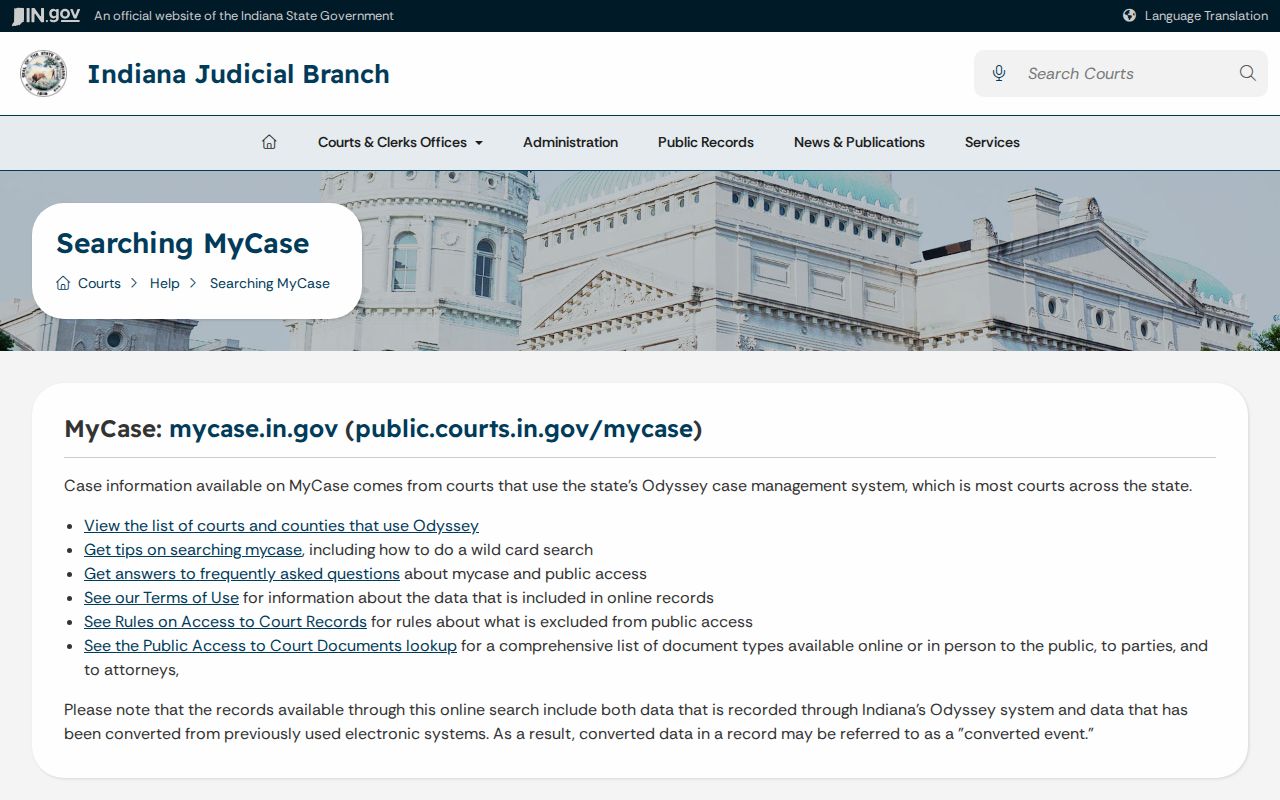
That official notice explains why a blank MyCase result is not clearance for a Wells County warrant check. Use it to identify the case, then contact the clerk.
Arrest Warrants, Summonses, and Bench Warrants
These records can share a chronology but mean different things.
| Record | Trigger | Effect |
|---|---|---|
| Arrest warrant | Indictment or probable cause | Authorizes arrest |
| Summons | Court command | Directs appearance |
| Bench warrant | Missed duty | Authorizes custody in an existing case |
A search warrant instead authorizes a search of a described place, person, or property.
Wells County Arrest Warrant Requests
Indiana's Access to Public Records Act, IC 5-14-3, opens a route to non-exempt county records. Address a reasonably particular request to the official who holds the record. Wells policy calls for a response within 24 business hours in person, or seven calendar days by mail, fax, or email. Those are response periods, not production deadlines. Inspection and preparation are free. Standard copies run $0.10 per page, and restricted portions may be redacted or denied with a cited exemption. To make a Wells County request, write “Public Records Request” at the top, date it, give contact information, and describe the record, date range, and office clearly. State whether you want inspection, paper copies, or digital copies. A categorical request or a request for a list of individuals must be written. Wells County policy also requires a noncommercial-use statement for a list of people unless another legal authorization applies. The response may approve access, estimate more time, provide records in stages, or deny part of the request with a specific exemption and a short explanation. One limit matters most. APRA obtains records. It cannot recall, quash, or clear a warrant, and an old log cannot certify anyone's status today.
Handling an Arrest Warrant in Your Name
If a Wells County warrant carries your name, call a lawyer first. Then find the issuing court and ask its clerk exactly what the order demands. The fix depends on the case and the judge: a scheduled appearance, bond, a motion to recall or quash, or some other court action. You might need a new hearing date or proof tied to a missed obligation. None of this guarantees a particular judge will grant relief. Wells County offers no online clearance button and no safe-surrender process.
- Confirm the court and active status.
- Ask counsel about a safe response.
- Get official appearance or surrender directions.
- Follow the order's bond or motion terms.
- Keep proof of the resulting court action.
Wells County's Circuit and Superior local rules include bail schedules. Treat a schedule as a framework only. The warrant or a later case order controls, a judge can change bail, stacked charges shift the math, and special restrictions may apply. Paying alone does not recall a warrant. Once you appear, post bond, or get a ruling, ask the clerk how it will show on the docket and when the sheriff-linked listing updates.
Important: Never approach or attempt to detain anyone based on a public list; call 911 for emergencies and use official channels otherwise.
Wells County Court Confirmation
The Wells County Clerk answers at 260-824-6479 for Circuit and 260-824-6483 for Superior. The courts use 260-824-6485 and 260-824-6508. Both sit at 102 W Market Street in Bluffton. Staff can pull records and explain process, but they cannot give legal advice. Federal cases go through the Northern District of Indiana Fort Wayne Division and PACER, and Indiana e-Tax Warrants involve tax collection, not criminal arrest warrants.